You’re Not “Finding” Your Purpose. You’re Building It.
By Nebulum

The Nebulum Podcast — Episode 17
There’s a man named Paul Rosalie who, along with a friend, was standing in the Amazon rainforest watching it burn to make room for a highway. He looked around for someone to call, someone with authority to stop it. There was no one. No police were coming. No government was going to intervene. It was the Wild West.
And in that moment, he realized: it was up to him.
That story — heard on a podcast this week — opened up a cascade of questions about purpose. Not just his purpose, but ours. What does it actually mean to have a purpose? How do people arrive at one? And is it possible, for most of us, who were raised to follow a fairly conventional path through life?
This episode is an attempt to work through those questions honestly.
The Myth of “Finding” Your Purpose
The most common framing around purpose is that it’s out there somewhere, waiting to be discovered. You hear it all the time: find your purpose, find your calling, find your why.
But this framing can become its own trap. It implies passivity — that you just have to search in the right places long enough, and eventually it will appear. And for the many people who don’t have a single, blazingly obvious obsession they’ve carried since childhood, that framing can leave them feeling broken, like they missed something everyone else got.
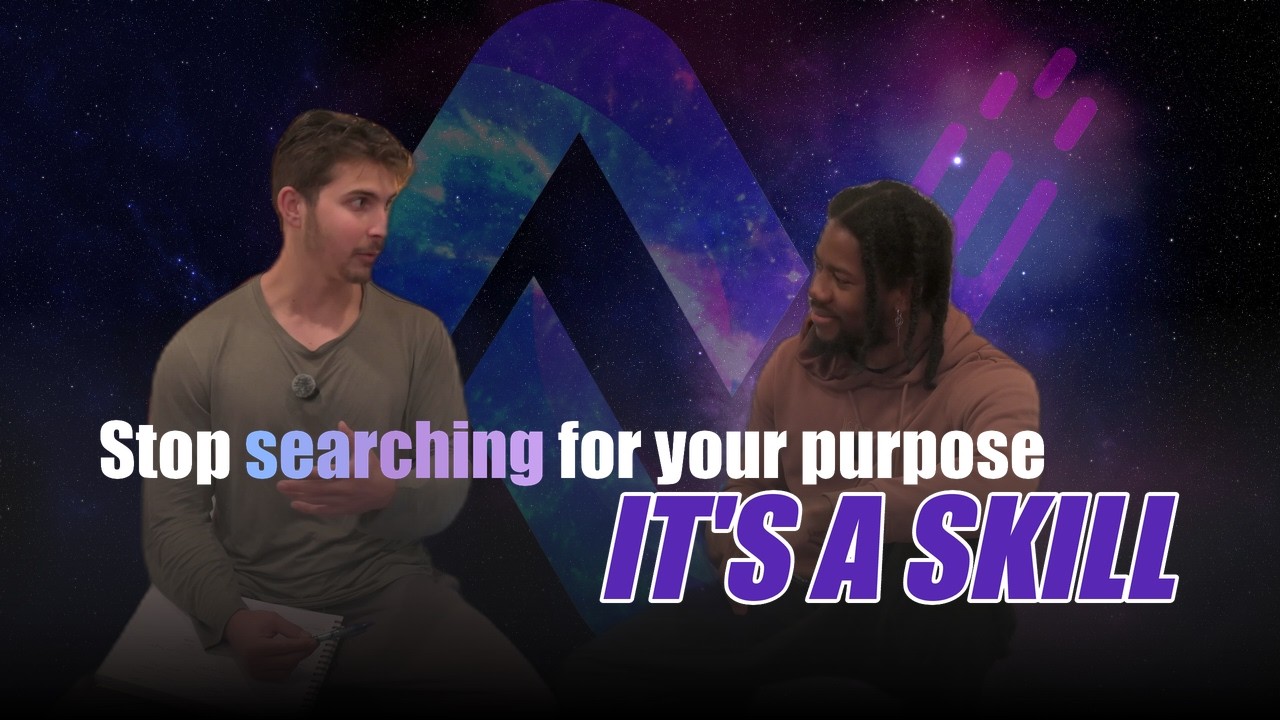
Here’s a different way to think about it: purpose is a skill.
Not something you find. Something you build, train, and practice.
There are multiple paths to arriving at a sense of purpose. Some people have been obsessed with one thing since they were young, had it reinforced by their environment, and it simply became their path. Some people have a life-altering experience that reorients everything. But for most people, neither of those things happens — and that doesn’t mean they’re out of luck.
For most people, it takes an active set of decisions, habits, and mindsets to feel purposeful. Purpose is a byproduct of those things — not a prerequisite for them.
Purpose Needs a Commitment
One way to see how this works in practice: consider providing for your family.
That desire — to help, to be the one who makes things better, to be a provider — was always there. But the shift into something that actually felt like purpose came through a decision: to commit to it. To claim responsibility for it, write it down as a core driver, return to it when motivation dropped, and let it become part of identity.
That kind of decision-making can feel counterintuitive because it involves taking on weight rather than relieving it. Saying this is on me is scary. Many people shy away from that level of ownership. But there’s a counterintuitive truth in it: the heavier the responsibility you voluntarily take on, the more energy it tends to generate — not less.
And that commitment doesn’t have to arise in a vacuum. You’re not going to decide to become a master gardener if you hate plants. The commitment grows from something real — a past feeling, an experience, a genuine pull in some direction. What you’re doing is taking that raw material and choosing to fuel it with focus and intention.
The more you repeat it, return to it, talk about it, and build your life around it, the more you feel it. Like any relationship: the more time and presence you give it, the deeper the connection becomes.
The Golden Handcuffs Problem
There’s a particular tension that comes up when purpose and certainty are in conflict — which, for most people in the modern Western world, they often are.
We have a strong need for certainty. It provides safety, stability, the basic material conditions of a decent life. And when you’re already on a path that reliably delivers that certainty — a stable job, a predictable routine, social approval — the activation energy required to divert from it is enormous. It’s not just a simple choice. It’s inertia. The current of a whole life flowing in one direction.
The pull toward something more purposeful can feel real and strong, and still not feel like enough to justify disrupting everything. There’s a word for this: golden handcuffs.
And there’s another layer to it. When you don’t have certainty, it’s actually harder to think about purpose, because your purpose becomes getting certainty. Purpose is a luxury that becomes available once the more basic needs are handled. Once they are, the question becomes: what am I using this stability for?
The answer to that question isn’t obvious or simple. And purpose itself isn’t static — it’s more like a river than a destination. It flows and changes over time, shaped by who you’re becoming and what life asks of you.
Purpose Is Your Why — And Your Why Is Your Needs
One clean way to understand purpose: it’s your reason for doing what you do. Your why. This is the core of Simon Sinek’s work, and it holds up.
And when you look closely at what makes something feel purposeful, it almost always comes back to needs being met. Not just surface-level preferences, but the deeper things: the need for learning, for connection, for growth, for contribution, for novelty, for love. When an activity or a direction in life fulfills many of these needs simultaneously, it tends to feel powerfully purposeful.
This gives a practical lens: rather than asking what is my purpose? in the abstract, ask what are my needs, and what kind of life could meet most of them?
Some of the answers that came up in this conversation: the need for deep problem-solving, for learning, for genuine human connection, for responsibility, for novelty. The life of a musician and entrepreneur, for example, hits a surprising number of those notes.
There’s also an art to this. It doesn’t have to be one single “soup” that contains everything — it can be a meal with multiple dishes. Some needs might be met by your work; others by relationships; others by creative practice. The question is whether the life as a whole adds up to something that nourishes the things most alive in you.
Values and Purpose Are Nearly the Same Thing
There’s a point in the conversation where it becomes clear that purpose and values aren’t really separate ideas. Your purpose is your reason for doing what you do. Your values are the things you care about most deeply. If you know your values — genuinely, not the surface-level version, but the real underlying things — you essentially know your purpose.
The gap between knowing it and feeling it, though, is real. And that’s where the skill comes in.
You can declare a purpose. You can write it down, understand it intellectually, be able to explain it to someone else. And still not feel the pull of it in a given moment. Closing that gap — actually aligning yourself to feel the why, to have it in your bones — that’s what takes practice.
How You Actually Practice It: Immersion and Action
If purpose is a skill, how do you train it? Two concepts:
1. Immersion
You are what you eat. So eat your purpose.
Continuously expose yourself to it. Surround yourself with the idea — through books, podcasts, videos, people. Find others who are living in alignment with this thing and study them: what they’ve done, what they’ve written, how they got there. Think about it often. Talk about it. Repeat it to yourself. Create situations that force you to engage with it.
Say no to things that don’t align. Say yes to things that do. The more you can saturate your environment and attention with this thing, the less space there is for anything else. Eventually it becomes the lens through which you see everything.
This isn’t a passive process. It’s a deliberate choice to orient your inputs around what you want to grow toward.
2. Action
The second practice is to take massive action — as soon as possible, and as boldly as you can manage.
If you realize you want to write a book, start writing immediately. Not next week. Not after you’ve planned it perfectly. Now. If you want to write songs, write one. Record it. Perform it at an open mic. Do something that actually scares you a little, and do it quickly.
Why? Because action creates momentum. It sets things in motion. It connects you to the reality of the thing rather than the abstraction of it. And importantly, it provides feedback — real, felt feedback about whether this direction is right, whether it moves you closer to your higher self or further from it.
Immersion fuels action — when your whole attention environment is saturated with something, taking action toward it feels natural, even inevitable. And action deepens immersion — doing the thing makes it more real, more yours.
Together, they’re the engine.
A Useful Internal Compass
One small but powerful heuristic from this conversation: when you take an action in pursuit of a purpose, notice whether — afterward, once the dust has settled — you’re glad you did it.
Not necessarily in the immediate moment. Action in the direction of purpose often feels uncomfortable at first. But if, looking back, you feel glad, that’s a signal. It means that action moved you closer to the person you want to be. If you consistently feel that way about the same category of actions, you’re tracking something real.
That feeling of gladness — quiet, settled, not performative — is one of the more honest compasses we have.
Reflection Prompts to Take With You
As you go about your week, a few things worth sitting with:
1. Think about what you’ve been immersing yourself in lately. Does it feel purposeful, or is it filling a void? Is there a book, a podcast, a person’s story that genuinely lights something up in you? Start there.
2. Do a values inventory. What are the things you actually care about — not what you’re supposed to care about, but what genuinely moves you? What deeper need or call sits under each one?
3. Is there an action toward something purposeful that you’ve been deferring? Something that scares you a little? Consider taking it — now, or as soon as possible — and notice how you feel afterward.
Closing Thought
The search for purpose often keeps people stuck precisely because it’s framed as a search. But purpose isn’t a thing you stumble onto. It’s something you grow, through the repeated, deliberate act of showing up for what matters to you.
Commit to something real. Immerse yourself in it. Take action, even before you feel ready. And pay attention to what moves you — not in a spectacular, life-altering-moment kind of way, but in the quiet, daily way that builds a life over time.
That’s the work. And it’s available to anyone willing to do it.
The Nebulum Podcast is hosted by Zale and Grant. New episodes weekly. If this episode gave you something to chew on, share it with someone who might need it — and subscribe for more.
 ▶
▶Listen to the episode
You're Not "Finding" Your Purpose. You're Building It. THIS is How.
The Nebulum Podcast · EP 17 · 48 min