
Stop Arguing to Win. Start Arguing to Understand.
By Nebulum

How the win-oriented mindset is quietly sabotaging your relationships — and what to do instead.
Most of us think we’re communicating. We’re not. We’re competing.
Thanks for reading! Subscribe for free to receive new posts and support my work.
We listen just long enough to find the gap in someone’s sentence where we can insert our rebuttal. We prepare our defense while they’re still talking. We dismiss conclusions we don’t like instead of engaging with the premises that led someone there. And then we wonder why our relationships feel shallow, our teams misalign, and our arguments never actually resolve anything.
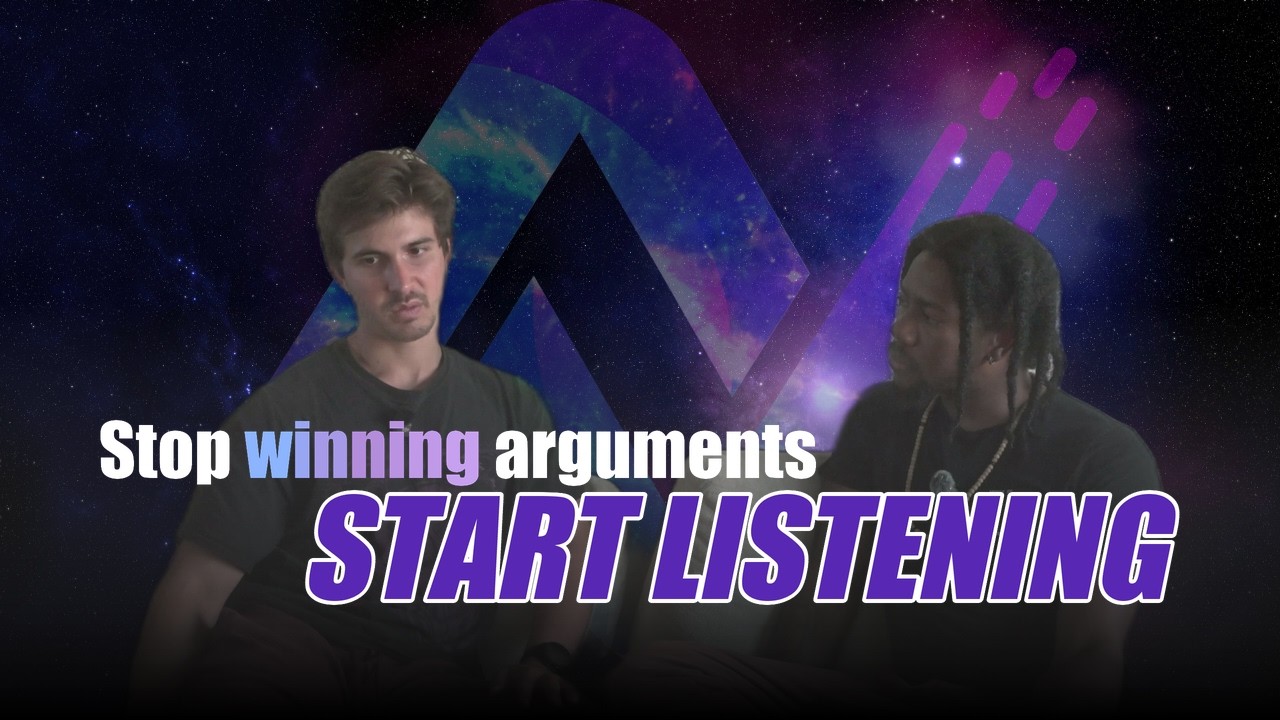
In Episode 23 of the Nebulum podcast, we dug into communication — what it actually is, why it’s foundational to a fulfilled life, and why the default way most of us do it is broken. Here’s the framework we walked through, along with the traps to watch out for.
Communication Isn’t Just Talking. It’s Landing.
At its core, communication is an exchange of information. But effective communication adds a crucial constraint: the information you intended to relay is the information that was actually received.
That gap — between what you meant and what landed — is where almost every interpersonal problem lives. You can say something perfectly clearly in your own head. But if the other person walks away with a different idea, communication didn’t happen. It tried to. It failed.
And this matters far beyond the immediate conversation. Communication is how we learn, how we teach, how we form relationships, how we negotiate, how we build anything with other people. If you’re on a path to a fulfilling life, at some point you’re going to need other humans to help you get there. You’re not going to find fulfillment in isolation. Being good at communication might be the single most leveraged skill you can develop.
The Mindset Shift: Winning vs. Truth
Here’s where most people get stuck.
There’s a habitual conditioning most of us carry: the belief that conversations are about being right. Someone says something, we feel challenged, and we lock in — not to understand, but to defend. We’re not listening. We’re just preparing our refute.
That’s a win-oriented mindset. And it has some telltale signs:
Disagreement feels like a threat to your identity. You get tense. Heated. Your voice rises. You’re almost in fight-or-flight.
You listen for the gap to insert your next point, not to understand.
You dismiss conclusions you don’t like instead of engaging with how the person got there.
Your self-worth is tied to being seen as correct — whether or not you actually are.
The alternative is a truth-oriented mindset. And it looks completely different:
Disagreement is information you didn’t have. It’s an opportunity, not an attack.
You listen to figure out what you’re missing. Then you update your model.
Your attention shifts from defending to exploring. You’re more relaxed. More curious.
There’s a built-in allowance that what you currently think may not be the truth.
The truth-oriented mindset reframes communication as a collaborative search for truth. If you’ve arrived at one conclusion and someone else arrived at another, that’s not a problem to be won — that’s a signal that one of you is missing something. Maybe both of you. The goal isn’t to prove who’s right. The goal is to figure out what’s actually true.
And even in scenarios where winning seems to be the point — say you’re a lawyer making a case — the truth-oriented approach still wins more. If you listen well enough to genuinely understand your opponent’s argument, you’ll hear its flaws more clearly than if you’d just been waiting to pounce.
The Path Framework: Why Everyone’s Conclusion Makes Sense (To Them)
Here’s a key insight: nobody arrives at a conclusion randomly. If two people disagree, there’s a path from their starting point to their ending point. And if you truly want to understand someone, you can almost always find that path. You’re not that different from them. You’re both human. You just took different routes.
Four things shape those routes:
1. Premises
What factual claims are they working from? What do they take as a starting point? A huge amount of arguments — maybe 90% — are actually two people arguing about completely different things because their premises never aligned.
Consider an argument about whether God exists. Most people jump straight into the argument without ever defining what they mean by “God” or what they mean by “existing.” If your root definitions differ, you’re not on the same plane at all. The arguments might sound similar, but you’re telling two entirely different stories.
This is why we started the episode defining communication. If you don’t define your terms, you’re building on air.
2. Assumptions
Assumptions are the premises you haven’t checked. They’re blind spots — unchecked statements you treat as given. And they’re everywhere.
One of the sneakiest assumptions is thinking other people’s minds work like yours. Maybe you assume they have an inner monologue because you do. Maybe you assume they noticed something you noticed. Maybe you assume they know why you’re asking for something, so you don’t explain.
Assumptions become dangerous when you start making decisions or treating people differently based on them. That’s where stereotyping comes from — an unchecked premise about a whole group of people becomes the starting point of your “logic,” and you never trace it back to see if it was ever true to begin with.
3. Emotions
Emotions color everything. Think of a glass of clear water; now stir in electrolyte powder. That’s what an emotion does to your thinking — it tints the entire field.
We like to pretend we’re rational. We’re not. We make emotional decisions and then backtrace the logic to justify them. Any argument, any discussion, has an emotional context underneath — for you and for the other person. Fear, pride, grief, resentment, hope — these frame what assumptions you make, what information you’re willing to hear, and whether you’re willing to communicate at all.
The same sentence can land completely differently depending on your mood. If you’re already feeling down, an offhand comment might feel like a personal attack. On a better day, you’d shrug it off. Understanding the emotional state — yours and theirs — is often more important than the words themselves.
4. Experiences
All of the above come from experience. Your premises, your assumptions, your emotional reactions — they’re all downstream of what you’ve lived through. Someone who’s been in a car accident reacts to roads differently than someone who hasn’t. Someone with trauma around a specific group of people will carry that into every related conversation.
Experiences are how you trace the path back. They believe this because they went through that. Once you see the experience, the conclusion stops looking irrational. It starts looking human.
Three Traps Everyone Falls Into
Even once you get the framework, three traps will pull you back into bad communication patterns.
Trap #1: Straw-Manning Instead of Steel-Manning
A straw man is an exaggerated, distorted version of someone’s argument — easy to knock down, but not actually what they said. Politicians do this constantly. Most of us do it without realizing.
The antidote is the steel-man: build the strongest possible version of the opposing view. Stronger than the person who actually believes it could make. If you can’t do that, you don’t fully understand the position — and without understanding, your own argument is just partial-data posturing.
Here’s the honest check: you can only fight straw. If your own argument only holds up against a distorted version of the other side, your argument might be straw too. You should want to put your steel up against actual steel. Otherwise you’re never really testing it.
Trap #2: Confusing “I Don’t Like It” with “It Is Wrong”
This one shows up constantly. Someone makes a valid argument you don’t like, so you dismiss it as wrong. But “I don’t like this” and “this is false” are completely separate claims. Emotional discomfort isn’t a refutation.
A useful gut-check: when you catch yourself saying “I don’t understand why anyone would think that,” ask yourself — do I actually not understand, or do I just not like it? More often than not, it’s the second one. And blocking understanding because you don’t like something means you’ll never actually learn why people disagree with you, which means you’ll never make a good case against them.
Trap #3: Treating Understanding as Conceding
This is maybe the most destructive trap. People are often afraid to even try to understand the other side because they think it means losing. If I pause to understand you, does that mean I’m agreeing?
No. Understanding is not agreeing. You can fully understand a position and still disagree with it. In fact, that’s the only kind of disagreement worth having. Disagreement from understanding is principled. Disagreement from refusal to understand is just stubbornness.
This fear is why you see people talking over each other, interrupting, refusing to even let a thought finish landing. Letting your defenses down long enough to understand feels like weakness. It’s actually the prerequisite for strength.
Find the Fork
When two people disagree, the instinct is to argue about the conclusion. That’s almost always the wrong place to fight. The real disagreement is usually much earlier in the chain — at the fork, where your paths first diverged.
Take a contentious issue like the abortion debate. People argue about the policy conclusion, but they usually diverge much earlier — often around whether a fetus is conscious, or when personhood begins. Those are the real forks. Arguing about the policy without ever naming the fork means you’re talking past each other indefinitely.
Sometimes when you trace back to the fork, you find a question that genuinely can’t be answered — one person’s starting assumption comes from faith, the other’s comes from something else. That’s okay. You don’t have to agree. But now you both know where you actually differ, and that’s often enough to stop hating each other and start finding common ground on the things you do agree on.
There’s almost always common ground. It’s rare that two people are actually on different planets. Usually you share far more premises than you realize — you just never bothered to check.
The AI Test
Here’s a surprisingly useful test for whether you’re communicating well: imagine you’re prompting an AI.
AI can’t read your mind. It has zero of your context. When you give a vague prompt and get a bad result, it’s very clear that you left information out — and the AI just filled in the gap with assumptions, which turned out to be wrong.
People work the same way. We constantly assume others have more context than they do. We leave them guessing. They fill in the gaps with their own assumptions. And then we get frustrated when the result isn’t what we expected — “they should have known!”
But they shouldn’t have. You didn’t give them the context. This is where responsibility comes in: if the information wasn’t conveyed and confirmed, it wasn’t communicated. Blaming the receiver teaches you nothing. Taking responsibility — I didn’t provide enough context — is where the improvement lives.
This is especially true in leadership. If someone doesn’t do what you wanted, the first question shouldn’t be “why did they mess up” — it should be “did they actually understand why this mattered?” Most of the time, the gap was in the transmission, not the person.
How to Actually Be Understood
If all of the above is about understanding others, here’s the flip: how do you get understood?
Two things:
1. Know your audience. You can’t communicate if you don’t know who you’re communicating to. Talking to an engineer and a senior executive about the same project should probably sound very different. Different vocabulary, different altitude, different framing. Same information, completely different packaging.
2. Open them up first. No matter how clearly you present your case, if the other person isn’t listening, it won’t land. And the way to open someone up is counterintuitive: understand them first. Make them feel heard. Make them feel appreciated. Explore their perspective with them, steel-man their view in front of them, show them you get where they’re coming from.
Once people feel understood, they become receptive. The adversarial frame collapses. They stop being an opponent and start being a collaborator. And it’s easy to talk to collaborators.
The Final Thought
There’s a quote we came back to in this episode:
“If you really understand someone, it’s hard not to love them.”
Love and understanding go hand in hand. When you really trace the path — their premises, their assumptions, their emotional landscape, the experiences that shaped them — the person in front of you stops looking like an enemy. They start looking like a human who ended up where they ended up for reasons that make sense, from the inside.
A world with better communication is a world with less hate. Less hate, because less division. Less division, because we stop assuming similarities that aren’t there and differences that aren’t there either. We start seeing the actual people across from us.
Your Challenge This Week
Pick an argument or a position you strongly disagree with — one that kind of bothers you. And steel-man it. Build the strongest possible case for it you can. Don’t just understand it; argue for it. Make a better version of the argument than its own believers would.
Then steel-man your own side against it. See how it holds up.
You don’t have to agree with the other side. You might, though — that’s worth being aware of. But more importantly, you’ll understand it. And understanding is where everything else gets built.
If this helped you rethink how you’re showing up in conversations, subscribe for more episodes on fulfillment, mindset, and the skills that actually change your life. And if you try the steel-man challenge, come back and tell us what you picked.
— Zale & Grant, Nebulum Podcast
Thanks for reading! Subscribe for free to receive new posts and support my work.
 ▶
▶Listen to the episode
You're Not Communicating — You're Just Fighting
The Nebulum Podcast · EP 23 · 56 min